Skip to:

The commodity fertility market is built on a convenient fiction: that a standardized product applied at a standardized rate will produce consistent results across different soils, climates, constructions, and management systems. It is a model that works well enough for average outcomes. It was never designed to produce exceptional ones.
Golf course turf management does not have the luxury of average outcomes. A putting surface that performs adequately in October is not the same as one that holds up through a heat event in July, recovers from aeration in four days instead of ten, or maintains consistent color and density through a drought period. The difference between those outcomes is rarely in the product category. It is the degree to which the program was built around the specific biology, chemistry, and management demands of that particular course.
Commodity fertility programs are built around averages — average soil, average climate, average management intensity. That design approach is economically rational for a product manufacturer selling at scale. It is agronomically limiting for any course that sits outside that average, which is most of them.
Consider the variables that define a course’s actual nutritional environment: soil texture and organic matter content, rootzone construction (native soil vs. sand-based vs. modified), irrigation water chemistry, climate zone and seasonal temperature patterns, turf species and cultivar mix, traffic intensity and recovery expectations, existing disease and pest pressure, and the biological baseline established by years of prior management decisions. No two courses share the same profile across all of these variables. A program calibrated to the average of that space will be miscalibrated for virtually every individual within it.
The practical consequence is visible in fertility response data. Courses applying identical NPK programs on similar construction often show dramatically different tissue nutrient levels, root development, and stress tolerance outcomes — because the variables that determine how nutrients move from soil to plant are not controlled by the product label. They are determined by the specific biological and chemical environment of each rootzone.
Four variables in particular make a strong case for program customization over commodity standardization:
The availability of every essential plant nutrient is pH dependent. A program that performs well on a buffered native-soil green may produce micronutrient deficiencies on a low-CEC sand profile drifting toward alkalinity — even with identical application rates. pH management is site-specific, and programs that do not account for it are making systematic errors.
Bicarbonate alkalinity, sodium adsorption ratio (SAR), and chloride levels vary dramatically between water sources. High-bicarbonate water drives pH upward over time, progressively locking out micronutrients regardless of how well the fertility program is calibrated. Sodium accumulation affects soil structure and water infiltration. These are site-specific variables that require site-specific responses.
The microbial community in a rootzone is the product of years of management decisions — fertilizer types, pesticide programs, cultivation frequency, organic matter levels. Two courses with similar soil chemistry may have dramatically different nutrient cycling capacity and biological activity levels, which means dramatically different responses to biological inputs. A program that does not account for the biological baseline will systematically over- or under-invest in biological inputs.
A course that hosts 50,000 rounds per year faces fundamentally different recovery demands than one at 20,000. A facility in a high-humidity climate with consistent summer disease pressure has different fungicide-fertility interaction dynamics than one in an arid environment. A generic program does not account for either of these issues.
Building a program specific to a course’s agronomic profile does not require starting from scratch every season. It requires three things that most programs skip or underinvest in: comprehensive baseline data, an interpretive framework that connects that data to specific management decisions, and a tracking protocol that documents whether those decisions are working.
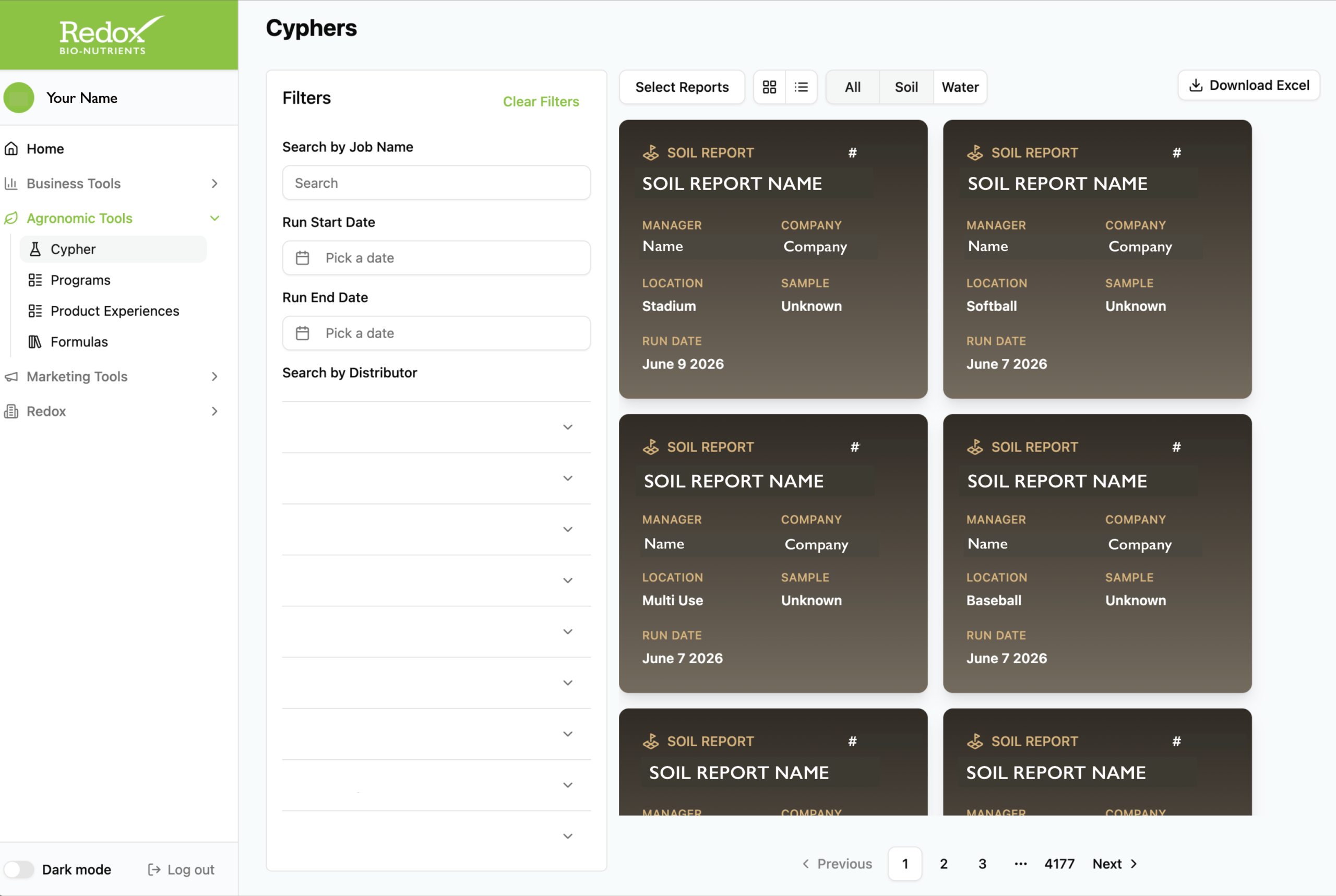
Baseline data means current soil and water analysis — not just a standard NPK panel, but a complete picture of what is actually available in the root zone. The Redox Cypher™ Soil Report was built for exactly this purpose: 42 critical data points drawn from both paste and soluble soil testing, designed to reveal the full pool of soluble nutrients available to the turf. Superintendents access Cypher through the Redox Dashboard, where soil and water reports can be submitted and reviewed with support from a Redox agronomist — translating raw data into specific program recommendations rather than generic guidance.
Most courses have some soil test data. Fewer have current tissue test data. Very few have updated irrigation water analysis. Cypher addresses that gap by treating soil and water chemistry as a unified system rather than separate inputs.

Bio-nutrient technology addresses the biological and biochemical variables that generic programs cannot reach – microbial communities, nutrient cycling, osmoregulatory function, root development. A standard application rate cannot account for them.
A TurfRx™ program built on Cypher soil and water data is not a premium version of a commodity program. It is a different approach, designed to address the specific biological and chemical reality of a particular rootzone rather than the statistical average of all rootzones.
Generic programs produce generic outcomes. The courses that consistently outperform their peers are not running generic programs.
Ready to move beyond the standard program? Explore how TurfRx™ bio-nutrient programs are built around site-specific soil and tissue data — not generic application charts. Visit redoxgrows.com/turf-bionutrients
Subscribe to receive our Redox Bio-Nutrients updates